
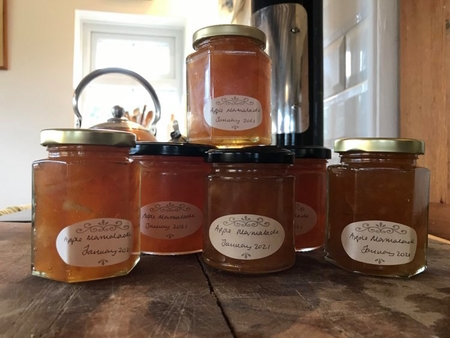
Recently I was talking to my 97 year old dad. “I’ve been eating the apple marmalade I made, and it’s really nice, it was my mum’s recipe”. In actual fact, it was from his mum’s cookbook, The Odhams Encyclopedia of Cookery, (Illustrated), circa 1950. ‘Apple marmalade? How can you have apple marmalade’, I thought, ‘surely a marmalade is made mostly of citrus fruits?’ Well, apparently, having looked up the definition of marmalade, it’s to do with the fact that there’s citrus included using the whole fruit along with the rind. Who knew?
A few years ago my dad gave me my mum’s copy of the cookbook, it’s well loved and well used and a bit dog eared. It’s also interleaved with recipes mum and dad have copied or taken from the newspaper, or handwritten recipes on scraps of paper which have been given to them by friends and family. If you ever get a chance to look through a copy of this particular book do. Published in the 1950s, it’s an interesting read if you enjoy cooking and enjoy a bit of culinary history. It’s worth bearing in mind that rationing didn’t end until the mid 1950s, so a lot of ingredients became available or abundant again which people had no or little experience of cooking with and this book guides the inexperienced cook in how to use these.
Some of the recipes look interesting, in a there’s no way I’m trying that way, for example the mock duck, which is basically a marrow stuffed with sage and onion stuffing, call me cynical but I don’t think I’d be fooled by that. It’s fascinating to see how tastes and cookery styles and fashions have changed over the years, in fact, just look at the way tastes have changed over the last 30 years, we seem to have moved from a more formal style of cookery to a more relaxed style, and we have also been introduced to a wider variety of ingredients and spices, which in my opinion is no bad thing. I have a lot of old cookbooks and I love looking at the recipes and the way the food was styled. I have also found that in these old books, although a lot of the recipes and ingredients are a bit dated and not to modern tastes, there is the odd gem which can be updated and revamped into a more contemporary style, so if you have any old cookbooks don’t discard them, they can be a good source of inspiration.
A nice preserve is pretty timeless so I thought I’d share dad’s recipe with you, I have tweaked it a bit, for one thing, once again I had to convert it from imperial to metric. It is, as dad said, really nice. The marmalade also has crystallised ginger in it, so it has a nice spicy warmth to it, perfect on toast on a cold, winter’s morning. It’s also really nice on a steamed sponge pudding.
Notes on Making Marmalade
Fruit – It is important to make sure that the lemons are properly washed as they are coated in a waxy substance to prevent spoilage, obviously you don’t really want this in your finished product.
Equipment – It is really important to use a large pan or preserving pan as the preserve will foam up. The pan should be no more than half full once the sugar has been added, and it’s always a good idea to make smaller batches as it’s easier to control. Also if things go badly wrong you’ve only lost a small quantity of ingredients.
Pectin – the gelling agent in marmalade and jams is pectin, you can get jam sugar which has it added, but for this recipe ordinary granulated sugar will be fine as the there is so much pectin in the apples. The acid in the lemons also helps the marmalade to gel.
Adding sugar – it is important to keep stirring until the sugar is dissolved, and then boil briskly until the setting point is reached. Be careful not to overcook the marmalade or the colour and flavour will be spoilt and if you’re really unlucky you’ll find yourself in toffee territory, (speaking from bitter experience here). It’s important to take the marmalade off the heat each time you test for a set.
Scum – a trick for removing the scum is to add a nob of butter to the pan, this seems to break the surface tension and sends the scum off to the edges of the pan so it’s easier to remove.
Bottling – Make sure the jars are thoroughly clean, I do this by washing them in washing up liquid and hot water and rinsing out any remaining detergent. I then put them into the oven set at 100°C and remove them about 10 minutes before I fill them as they need to be warm. If you put the hot marmalade into cold jars, or indeed hot jars, they may crack.
Ingredients (makes approximately 3kg)
- 2 lemons
- 1 lt water
- 1 kg cooking apples
- 1 ½ kg granulated or preserving sugar
- 100 g crystallised stem ginger, chopped
Method
Start the day before you are going to cook the marmalade.
- Wash the lemons and cut them in half lengthways
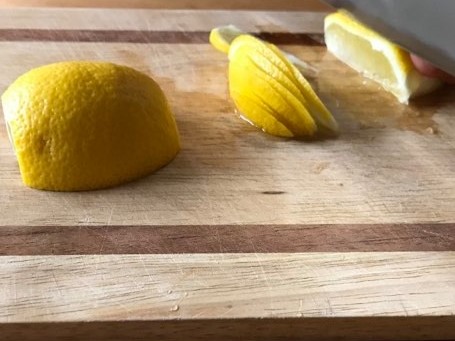
- Slice them as thinly as possible, place in a bowl and pour 1 lt of boiling water over them and leave until the next day.
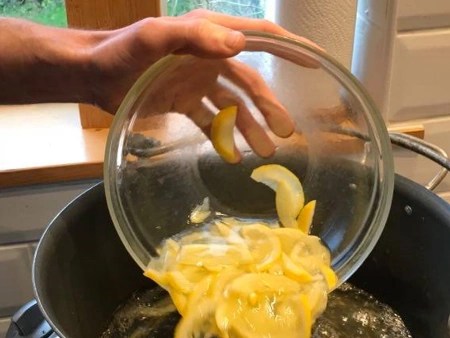
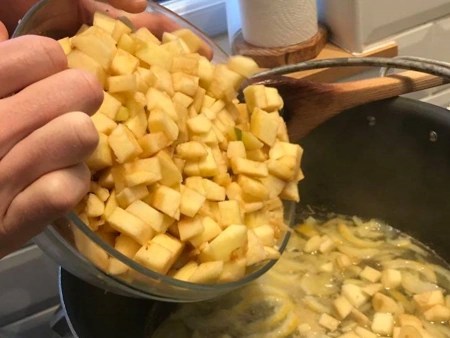
- While that’s happening peel, core and chop the apples. Once the lemons have simmered and softened, add the chopped apples and boil for 10 minutes.
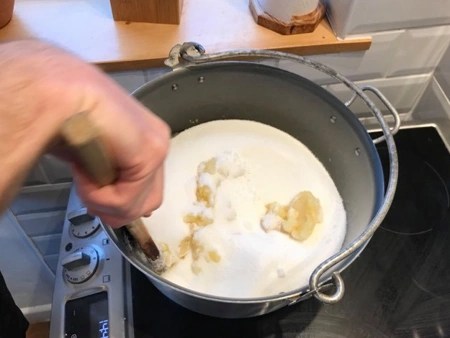
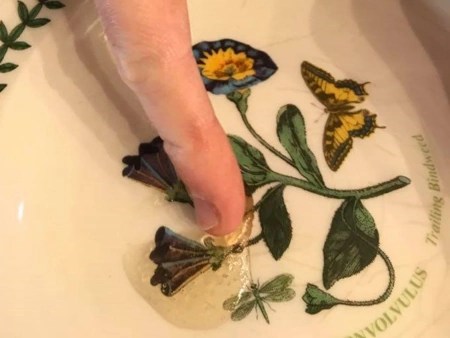
- Add the sugar and stir constantly until it is melted, then bring back to the boil, add the ginger after 10 minutes and after 15 to 20 minutes check to see if a set has been reached. To do this, remove the pan from the heat and put a small quantity on one of the cooled plates/saucers and set aside for a few minutes.
- If a skin forms on the top which crinkles up when you touch it a setting point has been reached. If you’re using a jam thermometer it should reach between 104-105°C. Skim any scum from the top of the marmalade.
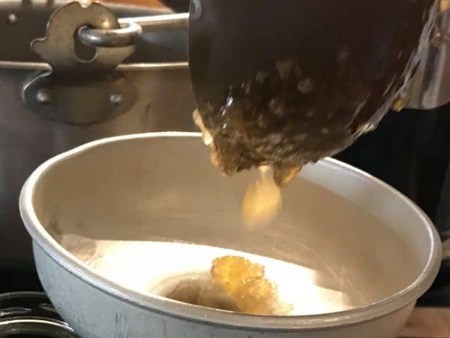
- Once a set has been reached, bottle in clean, sterile jars.
- Seal and label once cold and store somewhere dry and cool.
 Cavell Orchards